Gettysburg Leadership Experience | Normandy Leadership Experience
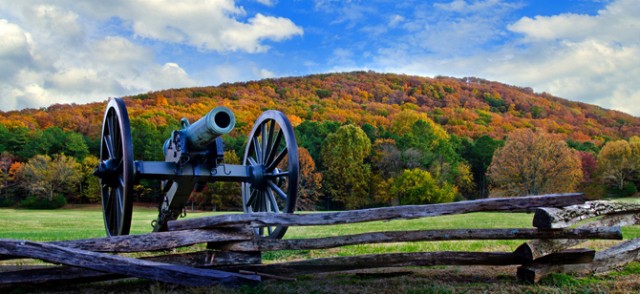
Our battlefield-based leadership experiences are designed to focus on leadership practices in the contemporary workplace by examining the decisions and actions of military commanders in the 1863 Battle of Gettysburg or the 1944 Normandy Invasion, and they are based on the long-standing military “staff ride” format for learning. In our battlefield Leadership Experiences, participants visit the sites, walk in the footsteps, and stand in the very positions of the military leaders in those long-ago encounters. By knowing what they knew and seeing what they saw, the experience “comes to life” in the present, and the emphasis in learning is focused on the how and why behind the events and actions in the battle, rather than on the tactics themselves. The experience tends to have a strong “team-building” effect as a by-product of the discussions, yet its emphasis is definitely on a more individually-oriented leadership development approach. When intact work teams participate together, the positive effect is compounded through the benefits of leadership improvement at an individual AND organizational (leadership team)level, as well as the gains through leadership team building as a derivative of the targeted customization of program content to highlight and illustrate certain leadership practices of special and particular relevance.
The indisputable fact is that – with its prevailing chaos, its de facto lack of clarity, its ambiguity and unpredictability, and its pressing need for split-second, moment-to-moment decisions, most often lacking the benefit of adequate information and all with real life or death consequences – battle is the ultimate test of leadership. And in battle, whether it is the tactical military variety or in the corporate arena, leadership is not an event or an orderly process. Rather, leadership is exercised and experienced through a sequence of opportunities presented moment to moment. And it is in these moments of opportunity, in their recognition or lack thereof, and in the actions taken or not taken as a result, that the real distinction between effective and ineffective leadership is recorded by history. It is in the absolute clarity of the historical record that battlefield leadership lessons take such vivid and visceral form.
Background on the “Staff Ride” Format
Battlefield Leadership’s battlefield experiences are designed to help corporate executives and managers reflect on leadership issues using the battlefield as a metaphor for many of the challenges faced in today’s competitive marketplace. After an initial briefing and strategic overview, we spend time on the field together, walking and riding over the very ground contested by military forces and armies long ago. This “staff ride” format is derived from long-standing military practice. More than a century ago, military students of leadership began visiting old battlefields with senior officers, staff members, and facilitators to analyze historic decisions and their consequences. These experiences developed an understanding of fundamental combat leadership practices and fostered team-building by providing leaders and their staffs with a shared experience focused on the problems encountered in actual battle. The method was later expanded to military students in advanced schools so that they could think about future battle challenges and contemporary solutions within the context of significant actions from the past. Later, the method was applied to senior civilian government leaders, many of whom were from corporate leadership backgrounds, who were shaping and directing military policy without the benefit of military experience.
Success with those audiences, and a sense of the direct applicability of the lessons from the battlefield to the corporate environment, led to using the staff ride method with corporate executives who were interested in building strong teams and engendering leadership qualities within those teams. We still use the label “staff ride” for these specialized leadership experiences, keeping in mind that:
The battlefield is a source of metaphors: Napoleon at Waterloo, Moore in the Ia Drang Valley, Winters at Bastogne, or Longstreet at Chickamauga, … any number of other battles and leaders could support the very same leadership learning goals as Gettysburg and Normandy. The battlefield simplicity helps us meaningfully and realistically appreciate such ubiquitous leadership considerations as the pivotal importance of plans alongside the overriding importance of improvising within the framework provided by these same plans. We ask how information is gathered and how decisions are made, communicated and modified. We explore the effect of leadership style on situational followership. We contemplate human motivation in the face of tremendous obstacles. We confront the capricious and seemingly random operation of “chance” or “luck” in human affairs. We see leaders of many types in trying situations, and we have the luxury of information and leisure necessary to analyze their performance in a way that is objective and blameless.
Thinking about growth
Gettysburg and Normandy also provide insight into the concept of progress and growth, typically perceived as forms of “change”, whether in terms of technology, organization, or doctrine. We will discuss the challenges associated with shedding old technology and tactics, as well as adopting the new. In organizational terms, we will examine how the antagonists in this great battle arrayed the intellectual and material resources available to them. Finally, in terms of doctrine, often the most fertile area for growth, we will see how these large organizations agreed they should use their resources to accomplish tasks.
Be alert for these issues as you read and listen before and during the experience. For instance, you might consider the use of cavalry at Gettysburg or the artificial harbors in Normandy. The Union and Confederacy had interestingly different ways (“doctrine”) of organizing and employing their mounted forces. At the time of Gettysburg, both armies were in the midst of applying “lessons” from earlier campaigns – a shared experience. Why did they follow different paths? Or, the dilemma of how to land large quantities of critical supplies on the Normandy coast in the face of strongly fortified harbors and beachfronts held by German forces presented seemingly insurmountable problems for the Allies. But the emphasis on the institutionalization of innovation by Churchill, along with his mandate for the rapid development of new doctrine in the use of such revolutionary facilities, enabled Alllied planners to conceive a strategy that was bound by the learned limitations of former tactical forays into occupied Europe.
Customization
The focus of the battlefield programs is to provide insights into and guidance for contemporary corporate leadership practices. Every participant emerges from these programs with new strategies for how s/he can be more effective as an individual leader. But, based on information gleaned from pre-session interviews or teleconferences with program sponsors and/or HR leaders, we can customize the content of a program and/or the emphasis placed on certain events and dynamics to create a focus on, or highlight the aspects of, leadership from the battle which are deemed most critical for a program’s participants based on the particular company or organization’s situation and needs. Facilitators will then tailor the leadership lessons from the battlefield to address the specific leadership needs identified. Additionally, the battlefield programs can also be modified to use and integrate companies’ respective core competencies and leadership models. Further, program agendas can be adjusted to meet specific time constraints and desires of the participant companies.
Existing Battlefield Programs
Battlefield Programs In Design
My focus over the last thirteen years has been, above all else, on leadership. During these years of inquiry, no one has defined leadership quite as succinctly or effectively as you did at our session; character and competency says it all.
Peter A. Darbee
Chairman of the Board
Chief Executive Officer
PG&E Corporation
[Your leadership insights] were no less than outstanding. I learned more these past two days of leadership training than any other course I have ever attended.
Ken Gills
Bayer HealthCare
Bayer Corporation
On behalf of International Paper, please accept my thanks for a great job in taking us through the Gettysburg experience. Your enthusiasm and deep knowledge about the subject made for a rich experience, and your energy kept everyone going through a very busy day. As leaders, our challenge is to take these new learnings and use them to motivate our people to help us take our company to the next level. Thanks again, and well done!
John T. Dillon
Chairman
International Paper