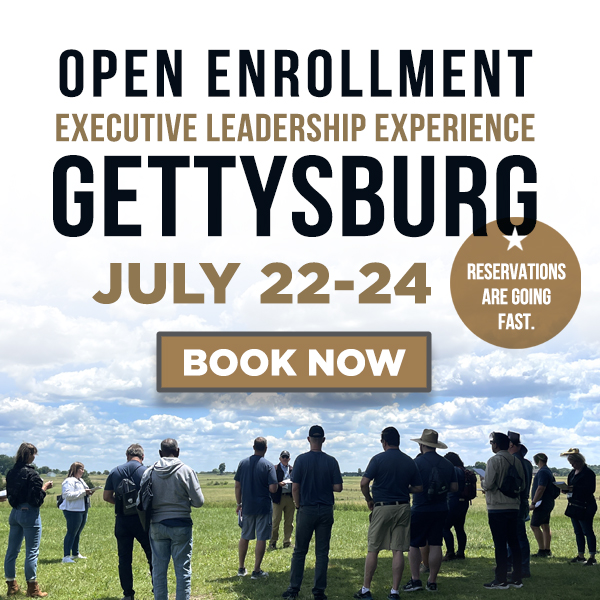
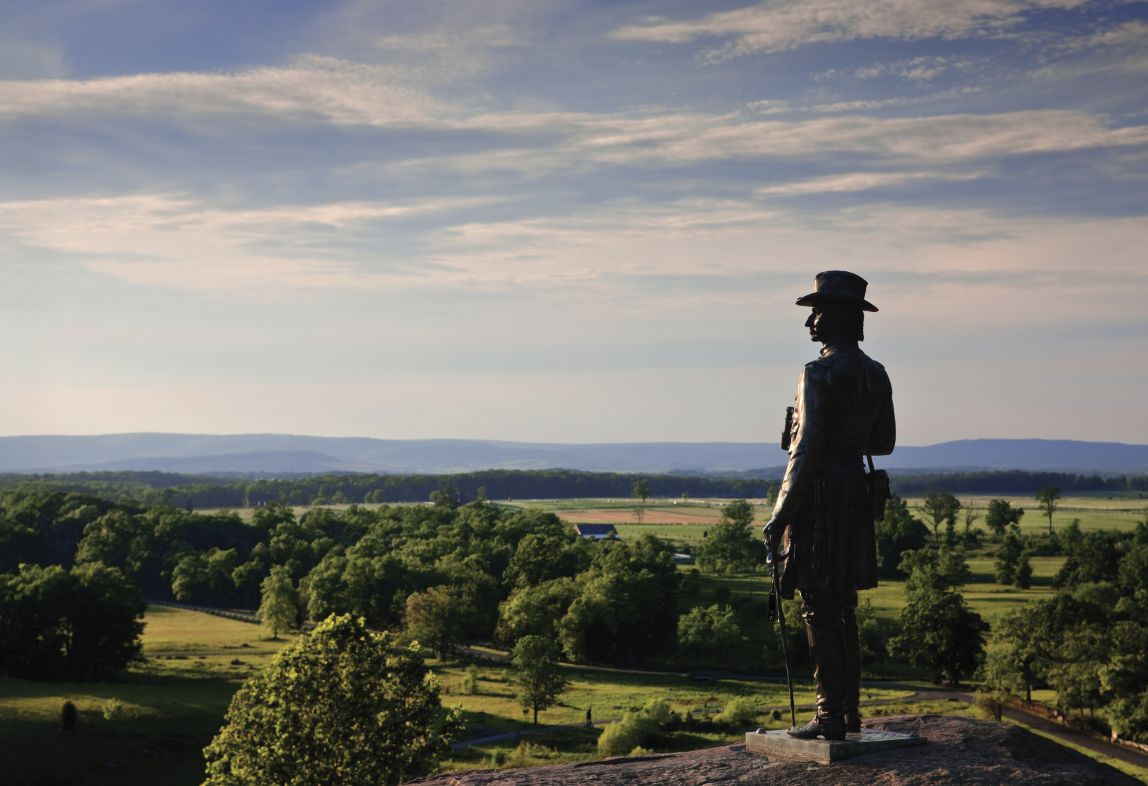

The Gettysburg Leadership Experience uses the July, 1863 Battle of Gettysburg as a leadership case study to focus on the challenges faced by leaders of large and complex organizations engaged in actions which shaped our nation’s history. We begin with the historical setting discussion at the Antrim 1844 Country Hotel, a unique antebellum manor house and now a four-star accommodation, or a fine local hotel in Gettysburg, depending on availability, and then we visit key vantage points on the battlefield itself using the military “staff ride” approach. Throughout the Gettysburg Leadership Experience, the historical context of the battle will be used to emphasize the role of the leaders in shaping the future, building and sustaining teams, managing process, and nurturing learning.

This rich and engaging battlefield metaphor provides an ideal setting within which to discuss:

The Gettysburg battlefield is especially attractive for our purposes because the battle is well-documented and its well-preserved battlefield vividly conveys the drama of Confederate General Robert E. Lee, at the height of his power, fighting to achieve decisive victory for the Confederacy through offensive operations into the enemy territory of Pennsylvania. The larger Union army, abruptly put under the command of General George G. Meade three days previously, had never come close to defeating Lee and was fighting its first battle under Meade’s direction. On both sides, leadership at every level contributed to the outcome.
The nature of the Gettysburg battle also contributes to its utility for our purposes. It was a large, complex operation that brought to bear the full spectrum of tactical capabilities in both armies, stretching leaders to their utmost limits. In a vivid way it spatially illustrates the intricate and complicated nature of the challenge of orchestrating different units and resources under separate commands for the combined benefit of entire armies. It depicts unmistakably the critical importance of an efficient and integrated supply chain to organizational functionality. Unlike many large operations, it was clearly focused in space and time, giving us an ideal framework for study. The documentation is extensive, the objectives are clear, and the sites necessary for in-depth analysis are easily accessible. Few of the notable battlefields from history satisfy these criteria so well.

Gettysburg is especially useful because each of the three days of battle was markedly different. On the first day, both armies became engaged in what can be called an “encounter battle” – there was no specific plan to engage at the location, and the Confederate army was even under orders to avoid an engagement – and each side fed forces into the fight as they became available. On the second day, General Lee had a plan for attacking the Union flanks simultaneously, but wholly unexpected changes in the Union dispositions forced last-minute changes in Confederate execution. On the third day, General Lee focused his main effort on the Union center, using several supporting efforts to improve the chances for success, but the Union was able to blunt each of these efforts. Leaders at every level adroitly adjusted their tactics to fit unexpected circumstances every day, and this gives us enormous opportunity under differing scenarios to explore that dynamic for learning about leadership.
The simple drama of the battlefield is the greatest pure source of both insight and inspiration. The efforts by a smaller Confederate army to defeat a Union force occupying strong positions will inevitably evoke questions and powerful emotion. The self-sacrifice of soldiers in both armies inspires admiration. As we try to transcend obstacles in our daily work, the battlefield lessons put our problems in perspective and offer valuable clues as to how we can improve our contemporary effectiveness as leaders and members of leadership teams.
Recommended reading prior to the session is Michael Shaara’s, The Killer Angels, and the Turner Entertainment movie, Gettysburg, is closely scripted following Shaara’s book if you prefer watching a story to reading it.
There is no better feeling for a champion of corporate learning than when a creative leadership development program makes an important difference for the organization AND wins over the skeptics. Battlefield Leadership is such a success story for General Mills. We first used Cole and Rich for one of our major division leadership teams. While some leaders were excited to use history and battles as a learning tool, others here weren’t so sure. But history came alive for all members of the team that week and it made a powerful impact on individuals and the working team. Since then numerous teams have sought out the Battlefield experience and we have an ongoing demand for this offering. I can highly recommend this program and also greatly value the partnership with the principal consultants.
Kevin D. Wilde
VP, Organization Effectiveness
and Chief Learning Officer
General Mills, Inc.
We are determined not to let the lessons we learned at Gettysburg go to waste. So I have dedicated two hours every month for leadership training. I’ve assigned each of my managers a month to run a session. Focus of each session is to make us better leaders individually and as a team by learning from each other.
Michael Hobbs
Vice President
Custom Services & Development
Novation
As always, you captured the minds and hearts of all who participated in the Leadership Experience. Your status in the lore of PHH urban legend continues to grow. I truly appreciate all you’ve done to further my leadership development and that of a growing number of leaders here at PHH.
Kevin C. Parker
Vice President
Business Development
PHH Arval